

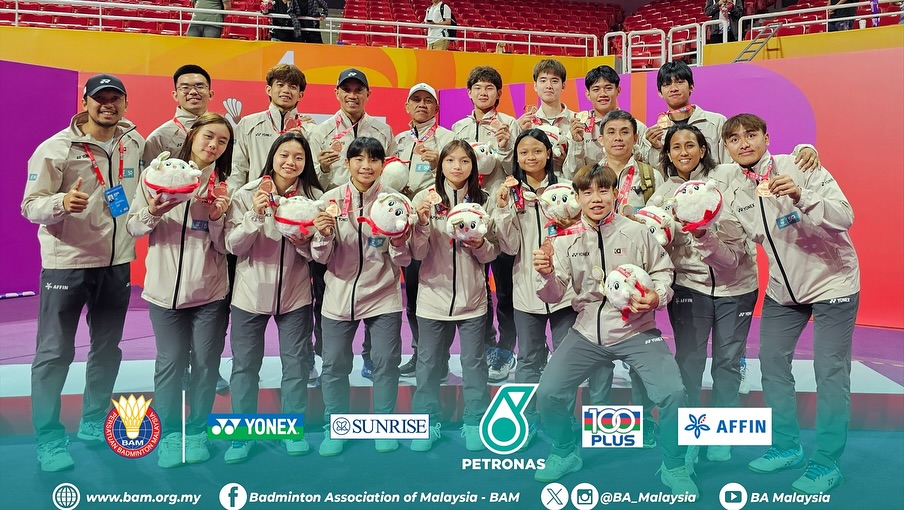

KUALA LUMPUR – Malaysia’s junior badminton players ended their campaign at this year’s World Junior Championships in Nanchang, China, with a haul of one gold, one silver, and one bronze, surpassing last year’s achievement of a single bronze in Spokane, United States.
In addition to defending the mixed team (Suhandinata Cup) medal, Malaysia secured silver in the girls’ doubles through debutants 14-year-old Low Zi Yu and 16-year-old Dania Sofea Zaidi.
Meanwhile, Aaron Tai and Kang Khai Xing ended the nation’s 13-year wait for the boys’ doubles crown, since Nelson Heg and Teo Ee Yi won it back in 2011.
What makes Aaron and Khai Xing’s triumph even more remarkable is that their victory places Malaysia ahead of badminton powerhouse China in the boys’ doubles category, in terms of titles won.
Since the tournament’s inception in 1992, China has dominated across all disciplines with a total of 71 titles, but Malaysia now leads in the boys’ doubles with eight gold medals, compared to China’s seven.
While this success bodes well for the future of Malaysian badminton, there are important lessons to take from this year’s World Juniors.
For one, not all the junior players came from the Akademi Badminton Malaysia (ABM). Players were also selected from the Bukit Jalil Sports School (BJSS) and a special pilot programme.
This includes players like Dania (BJSS), Datu Anif Datu Asrah (BJSS), Zi Yu (special programme) and Eng Ler Qi (special programme).
Previously, junior shuttlers were all brought together to train at ABM, where they also pursued the Cambridge International General Certificate of Secondary Education (IGCSE).
However, the Badminton Association of Malaysia (BAM) has since recognised that a one-size-fits-all approach does not work, nor can they place all their eggs in one basket, as far as development is concerned.
It is vital to understand that grassroots development involves various psychological factors that must be addressed.
With the recent announcement of the new coaching structure, it will be interesting to see how ABM coaching director Rexy Mainaky plans to shape the future development programme.
Former international player and coach Datuk Rashid Sidek sees many positives in having a larger pool of players to choose from. However, he remains cautious about the sustainability of this approach.
“Of course, it’s great to have more players to select from, but do we have enough quality coaches to train these juniors?”
“At the moment, we have the best coaches and facilities at ABM, and BJSS is well-supported, but what about the state level and local clubs?
“BAM can only do so much with state funding (provides around RM350,000 each to 15 affiliates), but that often only covers coaches’ and state BA staff salaries,” Rashid told Scoop.
“Some states are overwhelmed, with only one or two coaches handling a large number of players. On top of that, these players don’t have daily training sessions like those based at ABM or BJSS.
“In many cases, financially stable parents pay for additional private coaching and international tournament exposure.
“The big question is: where do we go from here? Will large corporations step in to fund these junior players, like they do in Indonesia or Japan?”
Junior development is an ongoing challenge that requires focused attention.
Malaysia clearly has no shortage of junior talent, but greater emphasis must be placed on how the sport can further excel from the grassroots level. — October 14, 2024