

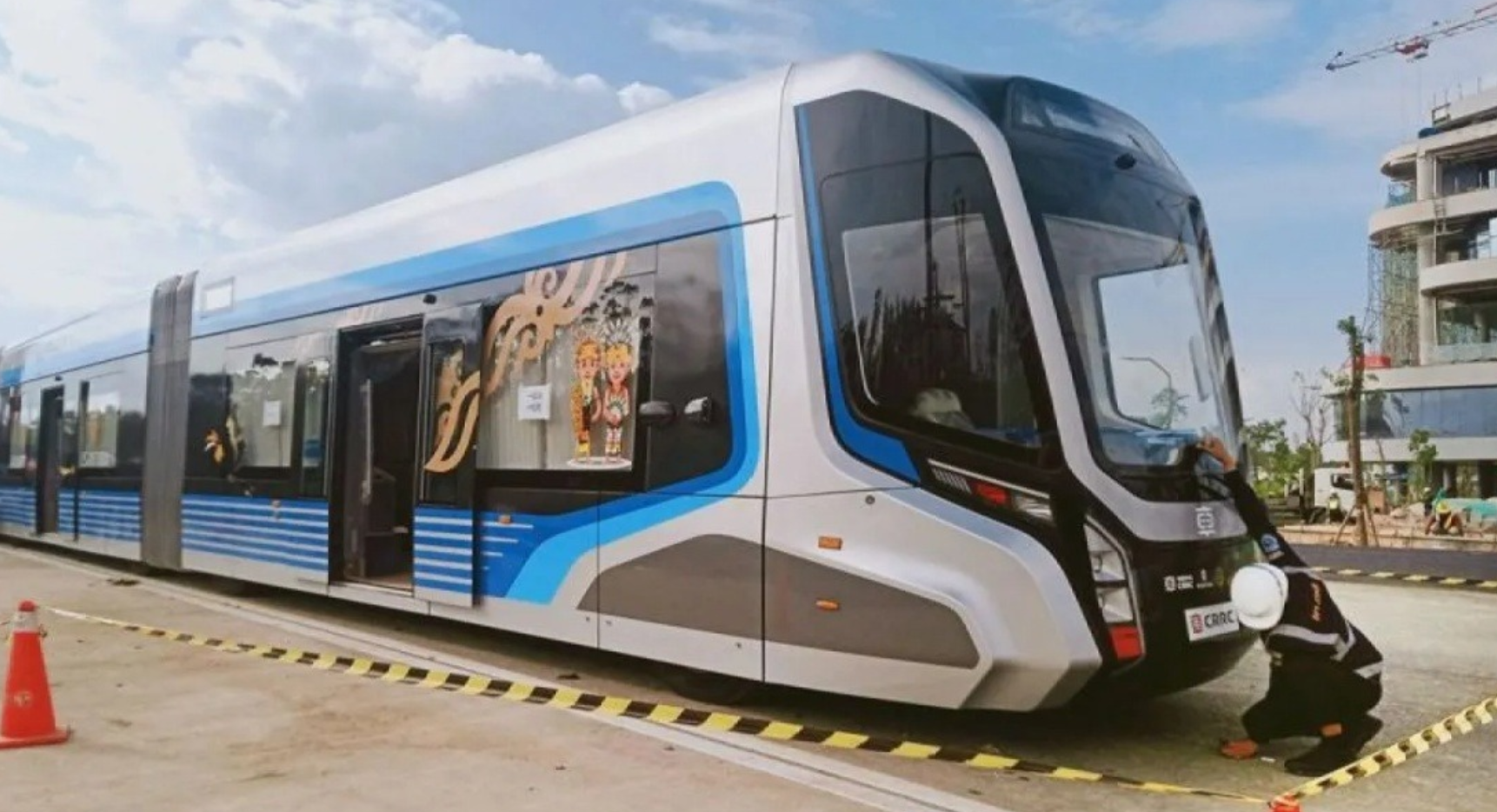
KUALA LUMPUR – The Indonesian government has decided to return the Autonomous Rail Transit (ART) vehicle, which was still undergoing trials in the planned National Capital City (IKN) in Nusantara, to China. This decision comes amid concerns that the train is not operating as expected.
According to the Jakarta Post, Indonesia wants to return the Chinese-made ART trains after they failed to function autonomously during trials conducted in September and October in the future capital city.
The ART system, described as a hybrid of a train, tram, and bus, utilises sensors and rubber wheels, and can operate both on and off tracks. This innovative transport solution is manufactured by the state-owned China Railway Rolling Stock Corporation (CRRC).
The Ministry of Transportation (Kemenhub) has assured that Indonesia will not suffer any losses from this return, as the trial funding is borne by the vendor.
“Regarding this trial, the memorandum of understanding (MOU) was made between the IKN authority and the vendor, Norinco, with participation from CRRC Qingdao Sifang.
Therefore, the authority responsible for evaluating whether the ART is suitable and meets the needs of IKN is the IKN authority,” said Budi Rahardjo, Head of the Communication and Public Information Bureau of Kemenhub, when contacted by Kompas.com on Thursday.
“However, following evaluation, it was determined that the autonomous system is not functioning properly in IKN, and therefore, the train will be returned. If the train fails to meet the evaluation standards set by the IKN Authority, it is not an issue, as the trial costs are covered by the ART vendor,” he added.
Budi further elaborated that the adoption of autonomous trains was part of the government’s vision to implement an environmentally friendly and futuristic transport system for IKN. The ART is battery-operated, which helps to reduce greenhouse gas emissions and reliance on fossil fuels.
Initially, the train was expected to undergo testing until December 2024. Mohammed Ali Berawi, Deputy for Green and Digital Transformation of the IKN Authority, clarified that during the assessment and evaluation, it was concluded that the train was not performing as anticipated.
“The result of the Proof-of-Concept (PoC) assessment revealed that the autonomous system of the ART was not functioning properly,” he told Kompas.com on Tuesday. – November 14, 2024