

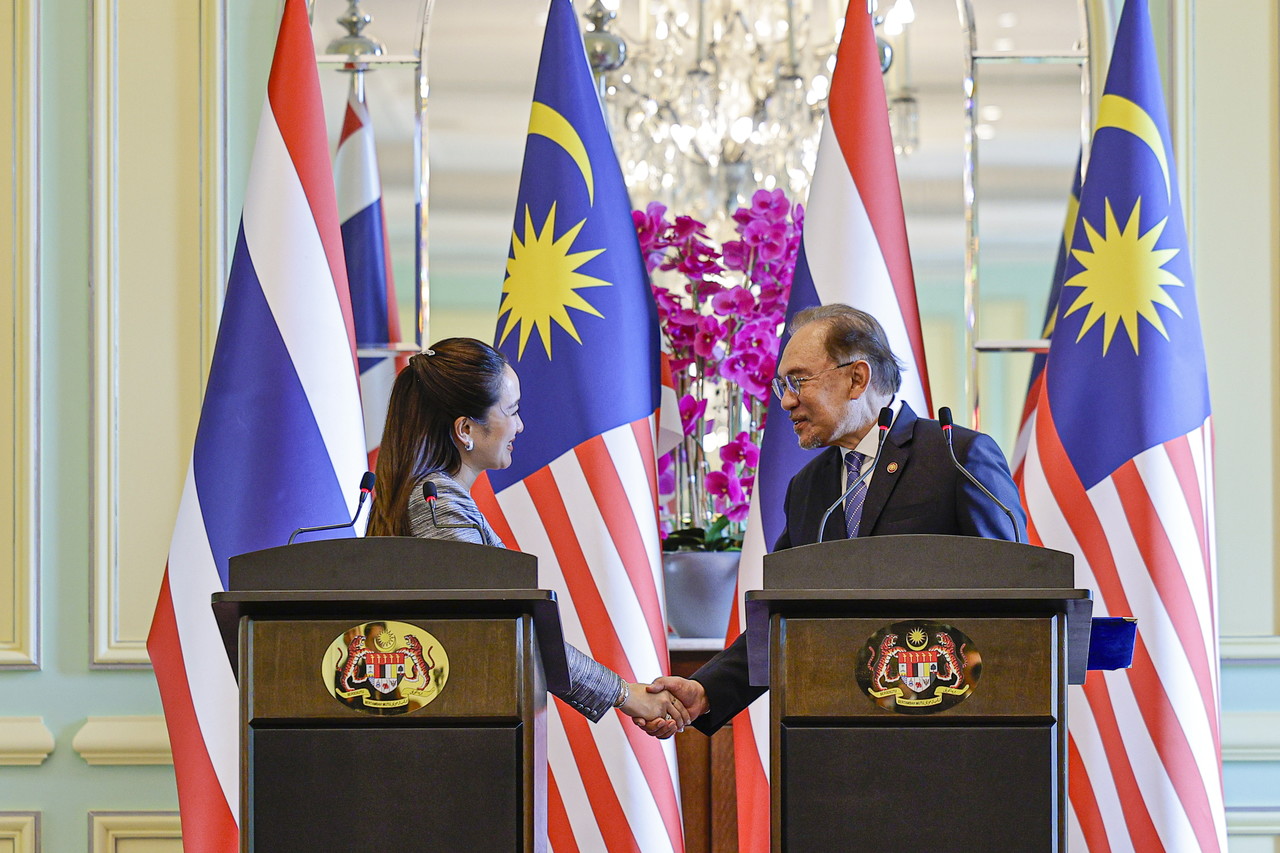
KUALA LUMPUR – Malaysia and Thailand have issued a renewed call for a peaceful and constructive resolution to disputes in the South China Sea, emphasising the need for all parties to uphold the 1982 United Nations Convention on the Law of the Sea (UNCLOS).
Prime Minister Datuk Seri Anwar Ibrahim highlighted the shared stance during a joint press conference with his Thai counterpart, Paetongtarn Shinawatra, following high-level talks held here today.
“We both agreed on the importance of the full and effective implementation of the Declaration on the Conduct of Parties in the South China Sea (DOC) and the early conclusion of a substantive and effective Code of Conduct (COC),” Anwar said.
The leaders underscored their commitment to resolving the disputes based on universally recognised principles of international law, including UNCLOS.
Focus on Myanmar crisis In addition to South China Sea issues, Anwar stressed the significance of ASEAN unity in addressing the ongoing crisis in Myanmar.
“What is also pertinent is our position on Myanmar. While we are committed to fully implement the Five-Point Consensus (5PC), we are taking measures through dialogues informally at different levels to ensure that Myanmar do participate and bring back Myanmar to the fore of ASEAN,” he said.
Anwar expressed gratitude for Paetongtarn’s steadfast support for Malaysia’s upcoming ASEAN Chairmanship in 2025.
In a joint statement, Malaysia’s Foreign Ministry (Wisma Putra) noted Thailand’s pledge to work closely with Malaysia during its chairmanship, particularly on sustainability initiatives and resolving the Myanmar crisis.
Thailand reaffirmed its commitment to advancing energy cooperation under the ASEAN Power Grid Initiative, reflecting a shared vision for a more sustainable and secure energy future in the region.
Both leaders also stressed the importance of existing energy initiatives, calling them pivotal for achieving regional integration and sustainability.
The South China Sea dispute involves conflicting territorial and maritime claims among several countries, including China, Taiwan, Vietnam, the Philippines, Malaysia, Brunei, and Indonesia.
The primary points of contention are the Spratly Islands, Paracel Islands, and Scarborough Shoal, among other features.
The dispute is driven by several factors as the South China Sea is a crucial maritime route for global trade, with an estimated US$3.36 trillion worth of global trade passing through it annually.
The region is believed to hold significant reserves of oil and natural gas, making it economically valuable. Each claimant country attaches symbolic value to the islands, which often exceeds their objective material wealth.
The disputes are complicated by overlapping historical claims and interpretations of international law, particularly UNCLOS.
The situation is further complicated by the involvement of external powers, such as the United States, which conducts freedom of navigation operations (FONOPs) in the region to challenge China’s extensive maritime claims. – December 16, 2024