

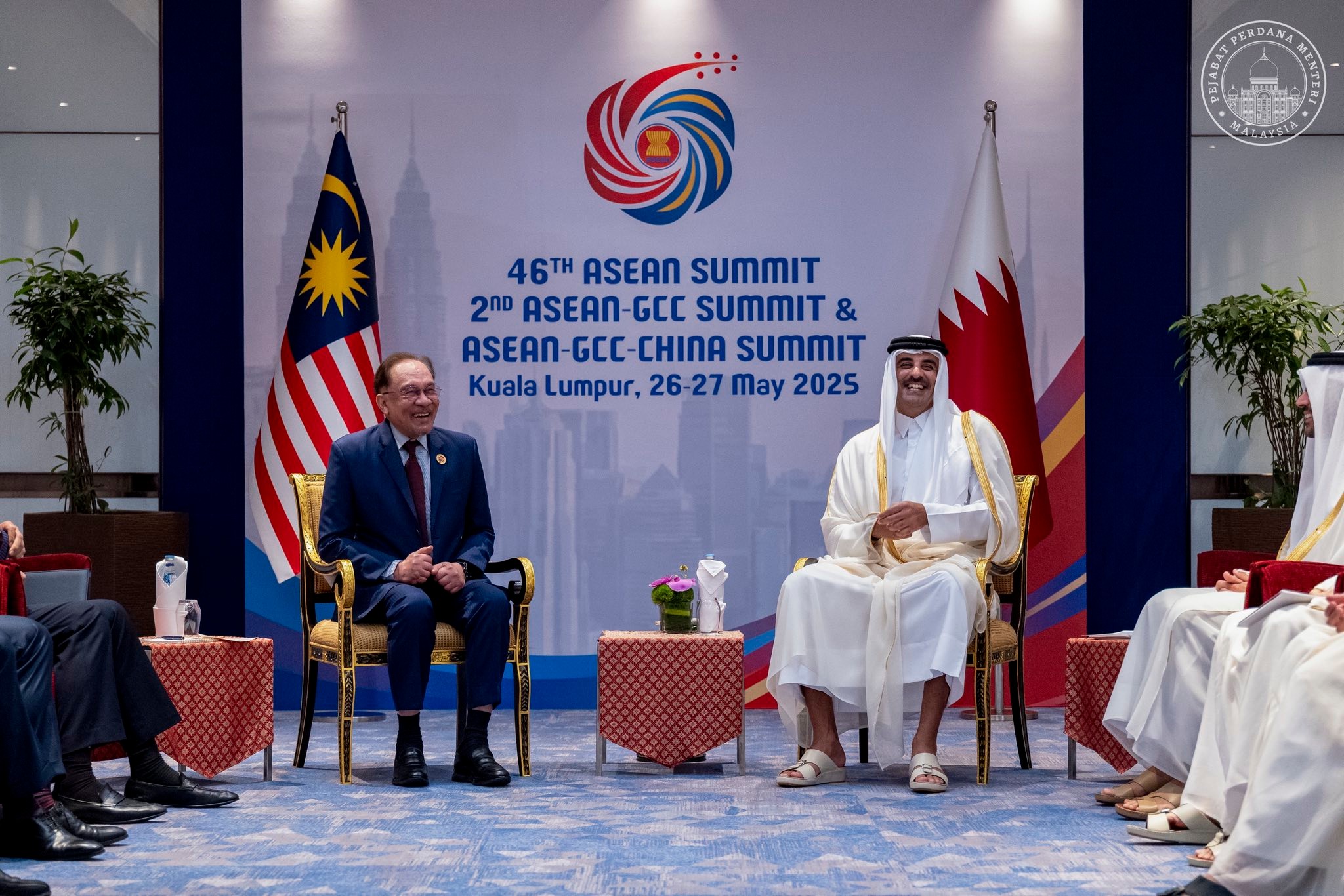
KUALA LUMPUR – Trade between Asean and the Gulf Cooperation Council (GCC) reached US$130.7 billion in 2023, with investment steadily growing – signalling deepening economic confidence between the two blocs.
As both regions navigate a challenging global landscape, leaders from Southeast Asia and the Gulf are now pushing for even closer collaboration.
Prime Minister Datuk Seri Anwar Ibrahim, in his opening remarks at the 2nd Asean-GCC Summit today, said the burgeoning partnership is not only timely but essential to strengthening interregional resilience and securing shared prosperity.
“In 2023, the GCC was Asean’s seventh largest trading partner. Investment is also growing, reflecting confidence in the long-term prospects of our partnership,” he said.
Anwar hailed the summit, held at the Kuala Lumpur Convention Centre, as “extraordinary” and a milestone for regional diplomacy. He said the presence of Asean leaders alongside representatives from the region’s most dynamic GCC economies marked a high point in mutual trust and friendship.
“This is, in our experience in this region, quite extraordinary – to bring together not only Asean leaders but also the most dynamic GCC countries…to build on trust, cooperation and true friendship,” he said, officially opening the summit.
The gathering builds on momentum from the inaugural summit in Riyadh in 2023 and the adoption of the Asean-GCC Framework of Cooperation 2024-2028, which Anwar said offers a clear blueprint to deepen collaboration across political, economic, and socio-cultural pillars.
“Today’s deliberations will be crucial in ensuring our partnership remains dynamic, responsive and impactful. Let us reaffirm our collective ambition and translate our shared vision into concrete cooperation,” he added.
The prime minister also highlighted that Malaysia’s Asean chairmanship theme for 2025, “Inclusivity and Sustainability”, aligns with both blocs’ shared values: stability through unity, prosperity through cooperation, and resilience through shared responsibility.
Top leaders in attendance include Brunei’s Sultan Hassanal Bolkiah, Indonesia’s President Prabowo Subianto, Cambodia’s Prime Minister Hun Manet, Laos’ Prime Minister Sonexay Siphandone, Vietnam’s Prime Minister Pham Minh Chinh, Philippine’s President Ferdinand Marcos Jr, Singapore’s Prime Minister Lawrence Wong, and Thailand’s Prime Minister Paetongtarn Shinawatra. Timor-Leste’s Prime Minister Kay Rala Xanana Gusmao also attended as an observer.
From the GCC, Qatar’s Emir Sheikh Tamim Hamad Al Thani, Bahrain’s Crown Prince and Prime Minister Salman bin Hamad Al Khalifa, Kuwait’s Crown Prince Sheikh Sabah Khaled Al-Hamad Al-Sabah, Oman’s Deputy Prime Minister Sayyid Asaad bin Tarik al Said, Saudi Arabia’s Foreign Minister Prince Faisal Farhan Al Saud, and UAE Supreme Council Member and Ruler of Ras Al Khaimah Sheikh Saud bin Saqr Al Qasimi were present. – May 27, 2025