

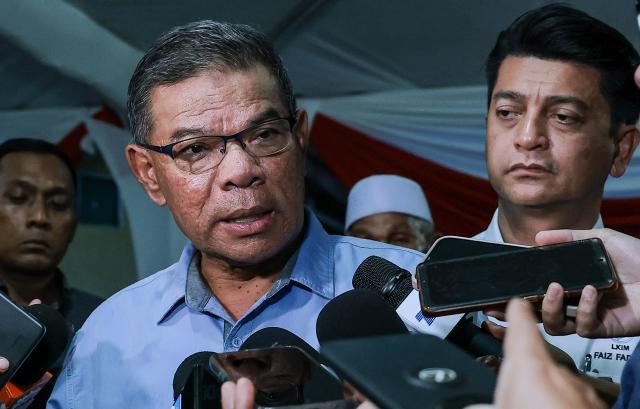
KUALA LUMPUR — The court should determine the differing interpretations of the High Court’s “discharge” order for former prime minister Datuk Seri Najib Razak, said Home Minister Datuk Seri Saifuddin Nasution Ismail.
Saifuddin told reporters in Melaka that is remains unclear whether the order constitutes a release, or allows him to serve the remainder of his sentence under house arrest.
He said the distinction between the terms “discharge” and “house arrest” had created a legal ambiguity that needed to be resolved by the court.
Saifuddin said the wording of the High Court’s order of discharge had raised a legal question, as the term “discharge” could be interpreted as an outright release. If so, it would mean that the Prison Department no longer had jurisdiction or authority over the individual, effectively amounting to a release.
This was fundamentally different from house arrest, under which the Prisons Department would retain authority over the individual, with the designated residence gazetted as the location where the sentence would be served.
“In the case of house arrest, the prison authorities would still retain jurisdiction; however, a ‘discharge’ means that the prison authorities no longer possess such authority,” he said after a visit to the Lereh Fishermen’s Jetty in Tanjung Kling, Melaka, today.
Saifuddin said the Attorney-General had been consulted on the matter and had provided his opinion, adding that the issue would ultimately be addressed in court.
“When there are two competing interpretations, the court is the most appropriate forum. The ministry will abide by and respect that process,” he said.
He stressed that the distinction was important because house arrest and release carried fundamentally different legal implications.
“How are we supposed to proceed when the ‘order of discharge’ specifies a ‘release’, yet the Pardons Board mandates ‘house arrest’? House arrest and release are two different things,” he said.
If the court interpreted the discharge order as requiring Najib’s outright release, his continued confinement under house arrest could potentially raise questions of wrongful detention.
“Consider the implications of the term ‘release’. If the court were to interpret it as a ‘release’, it would mean the prison authorities are required to set Datuk Najib free — that is what the order would dictate. Instead, however, he was placed under house arrest. This could potentially amount to ‘wrongful detention’ or something similar. It is a possibility,” he said.
Saifuddin also stressed that the government had not altered or disputed the decision of the Pardons Board.
“There is no issue whatsoever; we have not altered a single word, a single comma, or any detail at all, of the Pardons Board’s decision,” he said. – November 9, 2026